The TILMA
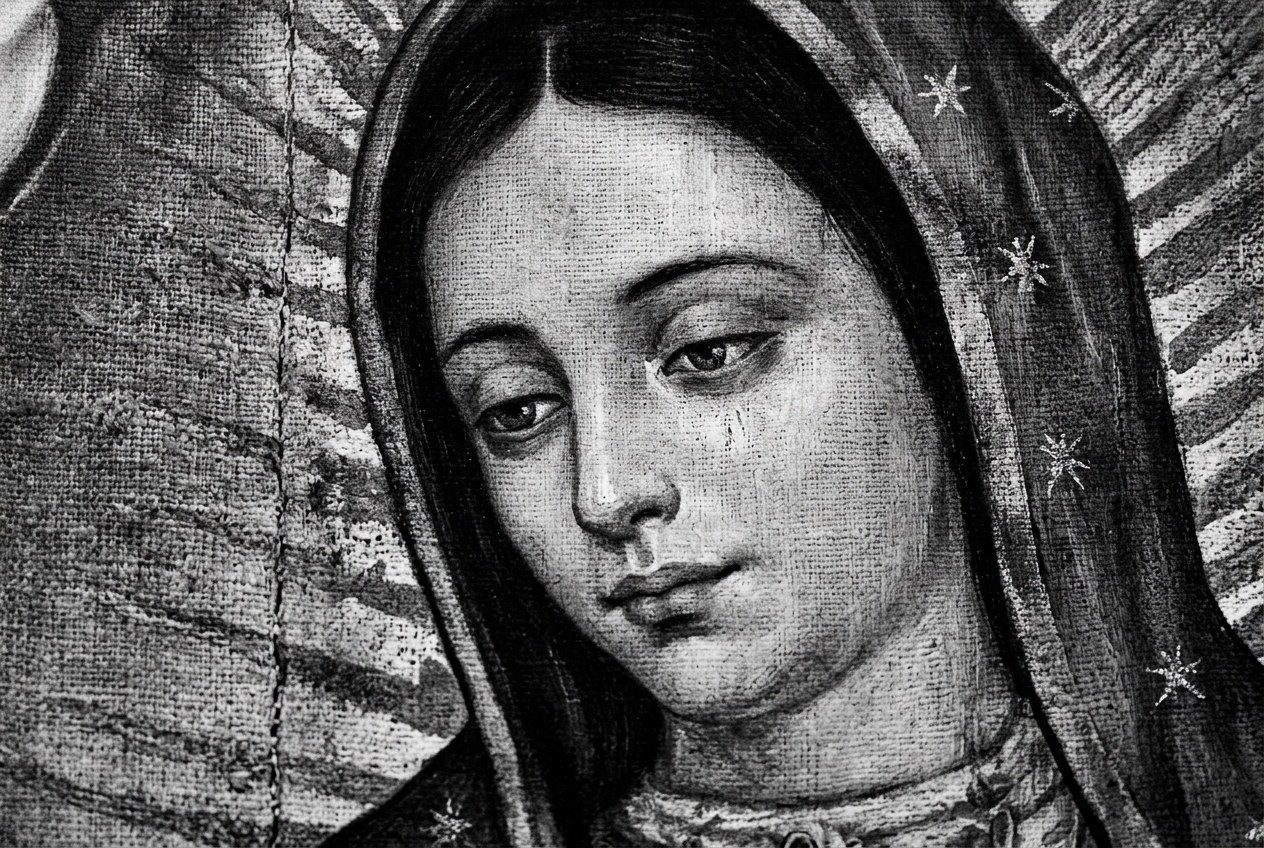
The tilma (cloak) of St. Juan Diego has survived nearly 500 years in conditions that normally destroy cactus-fiber textiles within decades. Five independent scientific disciplines have examined this object across five centuries, yet no unified natural theory explains the convergence of anomalies present on the image.
Historical Context: The Apparition at Tepeyac
On December 9, 1531, an indigenous Mexican peasant named Juan Diego reported encountering a luminous woman on Tepeyac Hill, north of Mexico City. Identifying herself as the Virgin Mary, she requested that the local bishop, Franciscan Juan de Zumárraga, build a chapel on the site.
Seeking a sign, Zumárraga sent Juan Diego back. On December 12, despite frozen winter ground, Juan Diego found Castilian roses blooming on the hill. He gathered them in his ayate tilma. When he opened the cloak before the bishop, an image of the Virgin Mary appeared imprinted on the cloth.
While skeptical historians note that early written documentation relies heavily on indigenous oral tradition (Nican Mopohua) and lacks a surviving firsthand diary entry from Zumárraga, the physical object itself exists today in Mexico City. The core evidence rests not on testimony alone, but on physics, chemistry, and optics.
Scientific Analysis & Material Anomalies
Textile Longevity: Ayate cactus fiber normally decays within 20–30 years. The tilma has survived nearly 500 years without rot.
Infrared Analysis (1979): Dr. Philip Callahan found no under-drawings, brushwork, or sizing/priming on the central figure.
Physical Resilience: Survived an accidental nitric acid spill (1785) and a bomb blast that bent a nearby solid iron cross (1921).
Fabric Longevity and Infrared Analysis
Woven from maguey cactus fibers, the tilma spent over a century unprotected by glass, exposed to candle smoke, salty air, and millions of human touches.
In 1979, biophysicist Dr. Philip Serna Callahan analyzed the image using infrared photography. His findings, published via the Center for Applied Research in the Apostolate (CARA), confirmed that the central figure shows no under-drawing or preliminary sketch lines, no brushstrokes or paint sizing/priming, and vibrant, microscopic color iridescence on unsized fabric.
While later human additions (such as the moon, tassels, and outer rays) show clear signs of human brushwork, the central image of the Virgin remains free of conventional painting techniques.
Environmental Survival: Chemical Spills and Explosions
1785 Acid Spill: A worker accidentally spilled strong nitric acid down the side of the cloth. The image remained intact, leaving only a faint stain that cleared over time.
1921 Bomb Blast: An anti-clerical operative hid a bomb inside a flower vase beneath the image. The explosion destroyed the marble altar and bent a heavy iron crucifix into a horseshoe shape. The tilma—and its ordinary protective glass—remained completely undamaged.