the incorruptibles
The bodies of certain Catholic saints have been found, upon exhumation, to be free from the decomposition that is the universal biological fate of all organic matter after death. The strongest cases, examined by physicians under oath in conditions unfavorable to natural preservation, with formal medical reports on file, cannot be explained by mummification, soil chemistry, or microenvironmental factors.
The Church itself has removed incorruption from its canonization criteria precisely because it acknowledges that natural explanations account for many cases — which makes the cases that survive that scrutiny all the more remarkable.
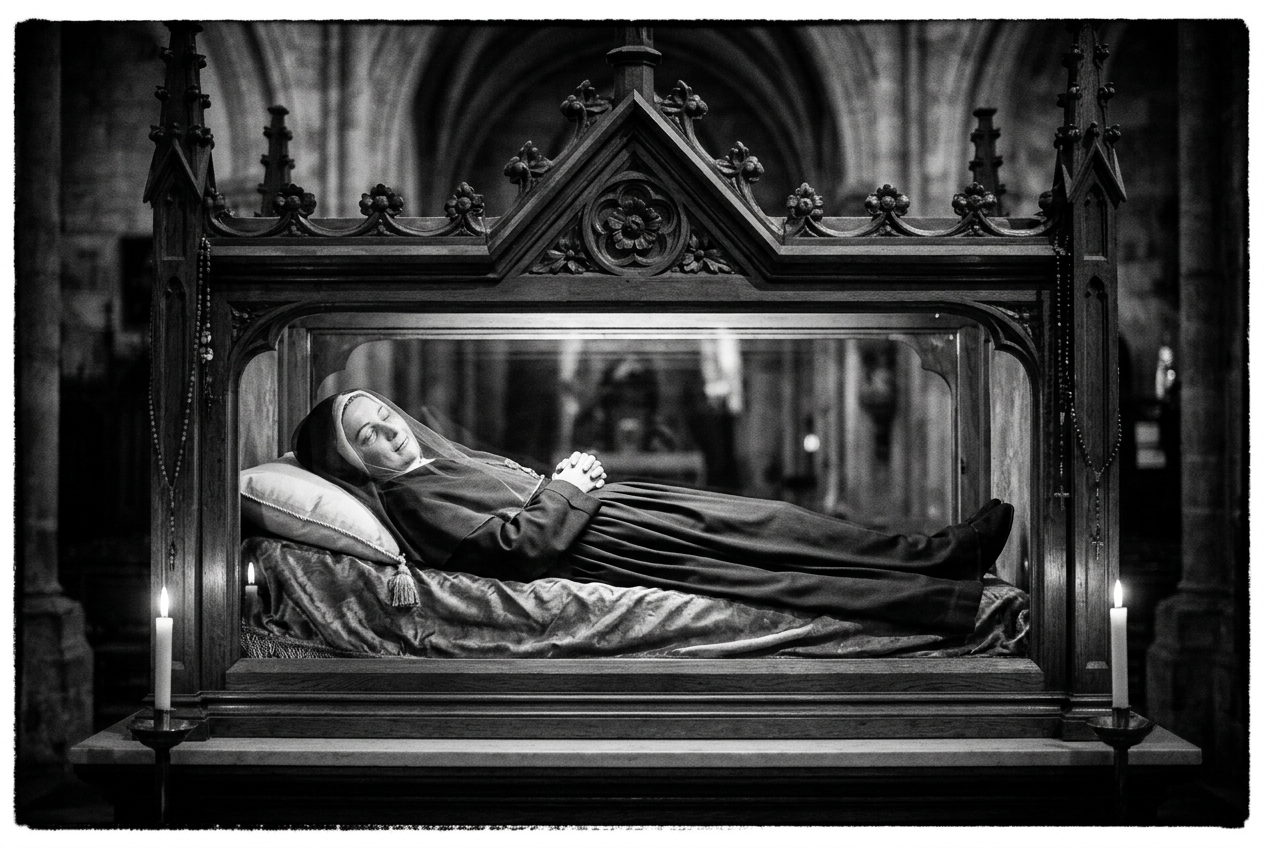
the incorruptibles
Skeptics have rightly pointed to natural mummification as an explanation for many cases of apparent incorruption. Researchers from the University of Pisa, with Vatican support, studied the microenvironments of former tombs of incorrupt saints and found that small differences in temperature, moisture, and construction techniques caused some tombs to produce naturally preserved bodies while others in the same church did not. This is an important and honest finding, and the Church has acknowledged it. But the University of Pisa study explains some cases, not the most dramatic ones. It predicts that bodies in dry, well-ventilated tombs are preserved. It does not predict that bodies in damp vaults — where metal corrodes and fabric rots — emerge with soft, pliable internal organs decades later.
The Biology of Decomposition
The biological process of decomposition is one of the most reliable processes in nature. Within hours of death, the body's own enzymes begin breaking down cellular structures. Within days, bacteria accelerate the breakdown of soft tissue. The liver, among the first organs to liquefy, typically begins decomposing within days of death. There are no known biological mechanisms by which a human body resists this process indefinitely without intervention.
Skeptics have rightly pointed to natural mummification as an explanation for many cases of apparent incorruption. Researchers from the University of Pisa, with Vatican support, studied the microenvironments of former tombs of incorrupt saints and found that small differences in temperature, moisture, and construction techniques caused some tombs to produce naturally preserved bodies while others in the same church did not. This is an important and honest finding, and the Church has acknowledged it. But the University of Pisa study explains some cases, not the most dramatic ones. It predicts that bodies in dry, well-ventilated tombs are preserved. It does not predict that bodies in damp vaults — where metal corrodes and fabric rots — emerge with soft, pliable internal organs decades later.
At the third exhumation in 1925, Doctor Comte filed a formal medical report. He wrote: "From this examination I conclude that the body of the Venerable Bernadette is intact, the skeleton is complete, the muscles have atrophied, but are well preserved; only the skin, which has shriveled, seems to have suffered from the effects of the damp in the coffin. The body does not seem to have putrefied, nor has any decomposition of the cadaver set in, although this would be expected and normal after such a long period in a vault hollowed out of the earth." Most strikingly, he noted the liver: "What struck me during this examination, of course, was the totally unexpected state of the liver after 46 years. One would have thought that this organ, which is basically soft and inclined to crumble, would have decomposed very rapidly or would have hardened to a chalky consistency. Yet it was soft and almost normal in consistency. I pointed this out to those present, remarking that this did not seem to be a natural phenomenon."Skeptics have argued that this describes mummification, not a miracle, and that mummification is a natural process. But mummification requires dry conditions; it is caused by rapid moisture removal from tissue. Bernadette's vault was demonstrably wet — wet enough to rust iron and corrode copper. Mummification and moisture-driven metal corrosion are contradictory conditions. You cannot have both simultaneously. Furthermore, mummification produces hard, desiccated organs. A mummified liver would be hard and chalky, not soft. Comte was a physician filing a formal report under oath, not a Catholic apologist. His conclusion was medical, not theological. And no one has refuted it.
The Case of St. Bernadette Soubirous
The case of St. Bernadette Soubirous is among the most thoroughly documented. Bernadette died on April 16, 1879, at age 35, after years of severe illness including tuberculosis of the lung and tuberculosis of the bone in her right knee. She was buried in a damp vault in the chapel of Saint Joseph at the Convent of Saint-Gildard in Nevers, France — conditions that should have accelerated decomposition. Her body was exhumed three times: in 1909, 1919, and 1925. At the first exhumation in 1909, thirty years after her death, the official medical report — signed under oath by Doctors David and Jourdan — recorded the body in a state of preservation with no trace of unpleasant smell. The hands were preserved, the nails intact, the teeth still in place, the hair still attached to the skull. The rosary in her hands had rusted and the crucifix had turned green; the metal had decomposed while the flesh had not. The wax mask issue must be addressed directly and honestly. After the 1919 exhumation, it was observed that Bernadette's face and hands had become discolored — the face showed a blackish tinge, and the nose was already sunken and shrunken. A wax mask was commissioned and applied over the face and hands before the body was placed on public display. This is a documented fact, and it is more significant than some Catholic accounts acknowledge: the face was decomposing, which is why the mask was applied. The mask covers the surface; it does not explain the preservation of the internal organs, which were examined directly by physicians and which no wax mask touches. The medical significance of the case rests on the internal findings, not the appearance of the face. But the facial decomposition should be acknowledged plainly, not minimized.
At the third exhumation in 1925, Doctor Comte filed a formal medical report. He wrote: "From this examination I conclude that the body of the Venerable Bernadette is intact, the skeleton is complete, the muscles have atrophied, but are well preserved; only the skin, which has shriveled, seems to have suffered from the effects of the damp in the coffin. The body does not seem to have putrefied, nor has any decomposition of the cadaver set in, although this would be expected and normal after such a long period in a vault hollowed out of the earth." Most strikingly, he noted the liver: "What struck me during this examination, of course, was the totally unexpected state of the liver after 46 years. One would have thought that this organ, which is basically soft and inclined to crumble, would have decomposed very rapidly or would have hardened to a chalky consistency. Yet it was soft and almost normal in consistency. I pointed this out to those present, remarking that this did not seem to be a natural phenomenon."Skeptics have argued that this describes mummification, not a miracle, and that mummification is a natural process. But mummification requires dry conditions; it is caused by rapid moisture removal from tissue. Bernadette's vault was demonstrably wet — wet enough to rust iron and corrode copper. Mummification and moisture-driven metal corrosion are contradictory conditions. You cannot have both simultaneously. Furthermore, mummification produces hard, desiccated organs. A mummified liver would be hard and chalky, not soft. Comte was a physician filing a formal report under oath, not a Catholic apologist. His conclusion was medical, not theological. And no one has refuted it.
Skeptics have correctly noted that many bodies labeled incorrupt are actually mummified, covered in wax masks, or only partially preserved, and that the Church itself has acknowledged this by removing incorruption from canonization criteria. This is a fair and important point. But it is also the point that makes the remaining cases stronger, not weaker.
Additional Cases
The breadth and geographic spread of incorruption cases makes environmental coincidence an implausible explanation. St. John Vianney, the Curé of Ars, died in 1859 and was exhumed in 1904 with his body preserved. St. Andrew Bobola, a Polish Jesuit martyr tortured and killed in 1657, was exhumed in 1702 — 45 years later — and found incorrupt despite a damp vault burial; his body is still displayed in Warsaw.
Skeptics have correctly noted that many bodies labeled incorrupt are actually mummified, covered in wax masks, or only partially preserved, and that the Church itself has acknowledged this by removing incorruption from canonization criteria. This is a fair and important point. But it is also the point that makes the remaining cases stronger, not weaker.
The Church's Own Skepticism as Evidence
The Vatican does not treat incorruption as a miracle per se. It does not require incorruption for canonization. It explicitly acknowledges that natural explanations account for many cases. It has removed incorruption from its canonization criteria precisely to avoid overclaiming. This is not the behavior of an institution manufacturing miracles from ambiguous evidence. It is the behavior of an institution that takes evidence seriously enough to distinguish between what it can and cannot explain. The cases that survive that institutional skepticism — St. Bernadette's soft liver in a damp vault, 46 years after death — are not the product of credulous acceptance. They are the residue after careful elimination. When a physician examining a body 46 years after death declares under oath that what he is observing "does not seem to be a natural phenomenon," he is making a medical claim. And no one has refuted it.