The TILMA
The tilma of Juan Diego has survived nearly 500 years in conditions that should have destroyed it within decades. Every serious scientific attempt to explain the image has failed to account for all of its anomalous properties simultaneously.
Five independent scientific disciplines have examined this object across five centuries. None has produced a satisfying natural explanation for the convergence of anomalies present in the central figure of the Virgin.
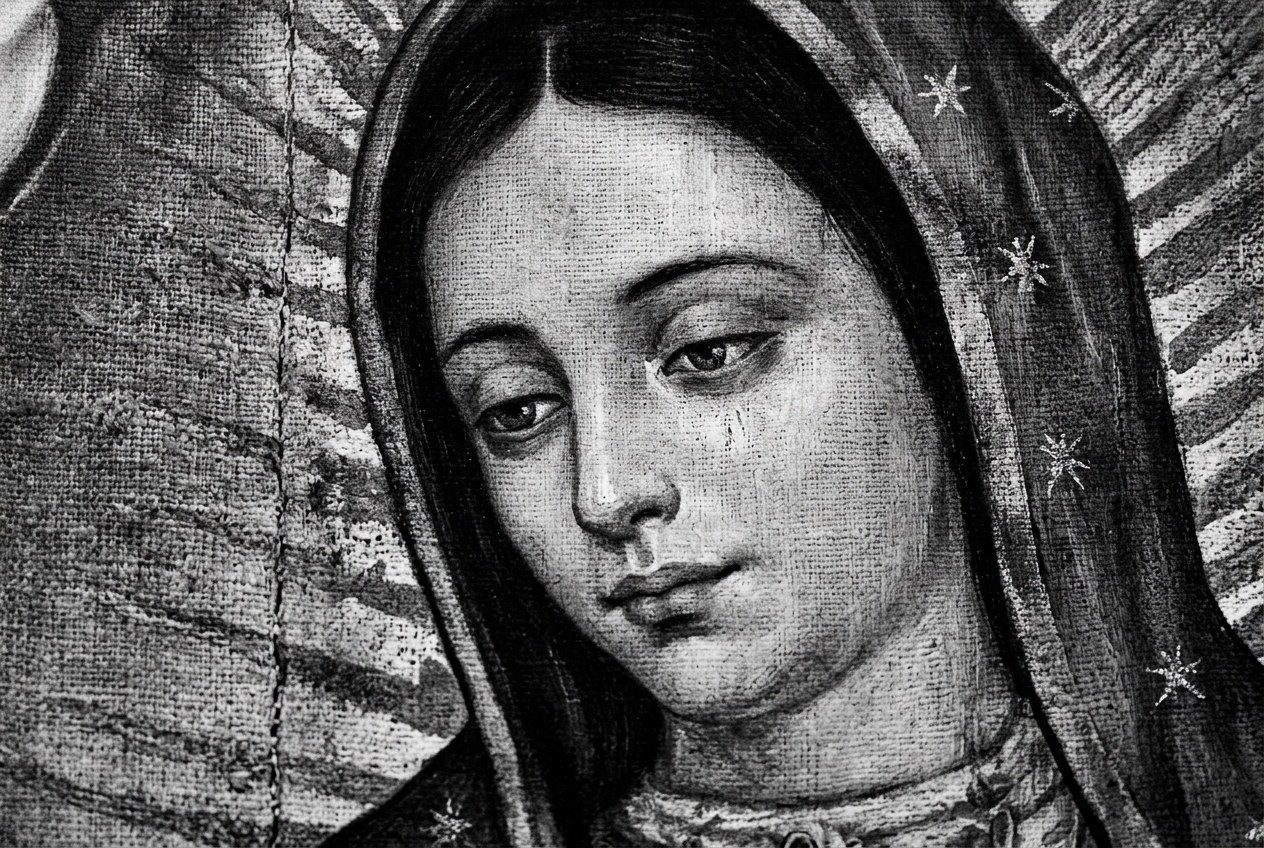
The Tilma
Skeptics have countered that a 1982 investigation by art expert José Sol Rosales concluded the fabric contains ordinary linen canvas, common among 16th-century painters, and that maguey codices from the same era have survived without miraculous explanation. These are fair points. The Rosales investigation was not peer-reviewed and was disputed by Church officials, but those procedural objections are secondary. More importantly, even granting Rosales's finding entirely, it does not resolve the central questions. Longevity of the fabric is the least remarkable of the tilma's anomalies. The question of how the image was formed remains entirely untouched by his findings.
The Fabric and Its Longevity
The tilma is woven from ayate fibers derived from the maguey cactus plant. Textiles of this kind have a normal lifespan of 20 to 30 years. The tilma has survived nearly 500, displayed openly for over a century with no glass protection, exposed to the smoke of tens of thousands of candles, the humid salty air of Mexico City, and the hands of countless pilgrims. Dr. Adolfo Orozco, a physicist who presented at the International Marian Congress in 2009, stated after exhaustive analysis that no scientific theory suffices to explain why the tilma shows no sign of deterioration in an environment that destroys similar fabrics within a decade.
Skeptics have countered that a 1982 investigation by art expert José Sol Rosales concluded the fabric contains ordinary linen canvas, common among 16th-century painters, and that maguey codices from the same era have survived without miraculous explanation. These are fair points. The Rosales investigation was not peer-reviewed and was disputed by Church officials, but those procedural objections are secondary. More importantly, even granting Rosales's finding entirely, it does not resolve the central questions. Longevity of the fabric is the least remarkable of the tilma's anomalies. The question of how the image was formed remains entirely untouched by his findings.
Skeptics have raised two objections. First, that Callahan's methodology has limitations. Second, that two forensic art analysts in 1985 argued infrared imaging can miss sketch lines detectable by other techniques. Both objections deserve honest acknowledgment. Callahan's infrared methodology is a standard tool in art analysis, not a fringe technique, and his expertise in optical physics and infrared radiation is legitimate and relevant. The 1985 analysts did not positively establish the presence of brushwork; they suggested it might be present and detectable by other means. No subsequent study has produced that positive evidence. The claim is not that Callahan's study is definitive; the claim is that in the 45 years since his examination, no study has refuted his central finding or produced a positive identification of conventional brushwork on the central figure. Callahan himself acknowledged that certain peripheral elements — the tassels, the crescent moon, the angel at the base — were added by a later human artist. This acknowledgment is significant: it demonstrates that the analytical tools he used were capable of distinguishing human additions from the central image. A later artist adding decorative elements around an existing image does not explain how the original image was formed.
The Image Itself: Infrared Analysis
Dr. Philip Serna Callahan — a research scientist at the University of Florida whose primary expertise was entomology and biophotonics, and who had extensive published work in infrared radiation — conducted a formal examination of the tilma on May 7, 1979, alongside Jody Brant Smith. His findings, published by the Center for Applied Research in the Apostolate (CARA) in 1981, confirmed under infrared examination that the central figure of the Virgin shows no traces of brushwork, no corrections, no under-drawing, and no sizing or priming of the cloth. Traditional painting on unsized cactus cloth would be nearly impossible; pigments would soak and blur. Yet the lines of the central image are crisp, the colors vibrant, and portions of the image exhibit iridescence — a color-shifting property associated with certain natural microstructures and rarely replicated in conventional painted surfaces.
Skeptics have raised two objections. First, that Callahan's methodology has limitations. Second, that two forensic art analysts in 1985 argued infrared imaging can miss sketch lines detectable by other techniques. Both objections deserve honest acknowledgment. Callahan's infrared methodology is a standard tool in art analysis, not a fringe technique, and his expertise in optical physics and infrared radiation is legitimate and relevant. The 1985 analysts did not positively establish the presence of brushwork; they suggested it might be present and detectable by other means. No subsequent study has produced that positive evidence. The claim is not that Callahan's study is definitive; the claim is that in the 45 years since his examination, no study has refuted his central finding or produced a positive identification of conventional brushwork on the central figure. Callahan himself acknowledged that certain peripheral elements — the tassels, the crescent moon, the angel at the base — were added by a later human artist. This acknowledgment is significant: it demonstrates that the analytical tools he used were capable of distinguishing human additions from the central image. A later artist adding decorative elements around an existing image does not explain how the original image was formed.
Skeptics have noted that neither event was conducted under controlled scientific conditions, and that certain blast configurations can spare objects that seem vulnerable. This is technically true. The argument is not that either event alone constitutes proof. The argument is cumulative: acid, a bomb, and 500 years of exposure that should have degraded the fabric. Any single survival might be explained away. The pattern across five centuries cannot be dismissed as coincidence without a positive alternative explanation for all three simultaneously. No such explanation exists.
Survival of Acid and Bomb
The tilma has survived events that should have destroyed it. In 1785, a worker accidentally spilled strong nitric acid on a large portion of the cloth. The image suffered no damage, with only a slight stain that faded with time. In 1921, anti-Catholic forces planted a powerful bomb hidden in a bouquet of flowers beneath the image. The explosion shattered the marble altar, bent a heavy iron crucifix into a horseshoe shape, and blew out windows throughout the basilica. The tilma, protected only by ordinary glass, was completely undamaged, and even the glass did not crack. That bent crucifix is still displayed in the basilica today.
Skeptics have noted that neither event was conducted under controlled scientific conditions, and that certain blast configurations can spare objects that seem vulnerable. This is technically true. The argument is not that either event alone constitutes proof. The argument is cumulative: acid, a bomb, and 500 years of exposure that should have degraded the fabric. Any single survival might be explained away. The pattern across five centuries cannot be dismissed as coincidence without a positive alternative explanation for all three simultaneously. No such explanation exists.
This finding is presented here as a reported and intriguing claim, not as an established scientific consensus. It has not been independently replicated by a secular astronomer in a peer-reviewed publication. The inversion claim is an interpretive conclusion that requires the prior assumption that the stars are intentionally mapped — which is precisely what is in dispute. Its evidential weight is real but appropriately qualified.
The Astronomical Star Map
In the 1980s and 1990s, Mexican astronomer Dr. Juan Homero Hernández Illescas used computer software to regress the night sky over Mexico City to December 12, 1531. His finding: the stars on Our Lady's mantle correspond to the constellations visible over Mexico on that precise date. He further noted that the image appears to be rendered from a perspective above the earth looking down — with north and south inverted — rather than from the perspective of a person on earth looking up.
This finding is presented here as a reported and intriguing claim, not as an established scientific consensus. It has not been independently replicated by a secular astronomer in a peer-reviewed publication. The inversion claim is an interpretive conclusion that requires the prior assumption that the stars are intentionally mapped — which is precisely what is in dispute. Its evidential weight is real but appropriately qualified.
The Cumulative Argument
Taken together, the tilma presents not one unexplained anomaly but several simultaneous ones across independent scientific disciplines: textile science cannot explain its longevity; infrared imaging cannot identify conventional brushwork on the central figure; chemistry finds iridescence not typical of painted surfaces; and history records its survival of acid and a bomb. The probability that all of these will eventually be closed by natural explanations — without any of them having been closed in 500 years of examination — diminishes with every passing decade of failed naturalistic inquiry.